
An AI agent for LinkedIn is a chat assistant like Claude or ChatGPT handed a set of tools that can read and act on your LinkedIn account. Connecting one is now the easy part, so the question that decides whether it is safe is narrower: what can the agent see, what can it send without asking, and which limits is it unable to raise?
Reach is a LinkedIn tool that runs inside your own logged-in Chrome session and exposes a scoped set of tools over MCP, so an agent can read your network, plan campaigns and draft messages without ever holding your LinkedIn password or session. This post is about where the line sits, and it uses our own account as the worked example, including the parts that look bad.
Why this got easy in September 2026
On 10 September 2026 OpenAI put its Agents API into public beta, "bringing that same harness and infrastructure that powers Codex to developers through a simple, flexible API." The page states plainly that "The Agents API supports MCP, custom functions, and built-in tools like web search," and MCP is right there in the first code sample, a server label and an HTTP URL. Six lines of configuration and an agent has hands in another system.
The same day, Harness published The State of Agent DLC 2026, a survey of 700 technology professionals at enterprises of 1,000-plus employees, run by Sapio Research in July 2026, screened so that every respondent had already deployed agents. Confidence landed in the mid-70s across testing, security, inventory, cost and rollback. The controls behind it did not. "77% are confident they have a complete inventory of every agent, MCP server, and LLM in their environment, but only 44% run active discovery tooling to verify it." And on stopping one: "76% believe they could disable a misbehaving agent in under 15 minutes, but only 33% have an instant kill switch in place."
So the plumbing arrived before the brakes. That is the context anyone should hold before pointing an agent at a LinkedIn account with fifteen years of relationships in it.
What is an AI agent for LinkedIn?
It is not a model that logs into LinkedIn. It is a model that calls tools someone else wrote, and the tools decide everything. An agent given a search_people tool and a draft_message tool can research and write all day and still be unable to send anything. An agent given a browser and your password can do whatever it likes, and you will find out afterwards. Same model, same prompt, completely different blast radius.
That is why the useful comparison between LinkedIn agents is not which model they run. It is the tool list.
Can ChatGPT or Claude actually connect to LinkedIn?
Not to LinkedIn itself. LinkedIn does not hand out general programmatic access for outreach, which we went through in detail in turning your LinkedIn connections into a CRM. An agent connects to a tool that already has a legitimate seat at your account, and that tool decides what to expose.
With Reach the seat is your own browser. The Chrome extension works inside the session you are already signed into, the server never calls LinkedIn, and the MCP layer sits above that with a fixed list of tools: read the plan, read the pipeline, qualify people against your target audience, propose a message, look at results. The agent gets the vocabulary of the account. It never gets the session.
This post was written by an agent running exactly that way. Everything below came out of those tools this morning.
What should an AI agent for LinkedIn be allowed to do?
Three things settle it, and they are worth checking in any tool before you connect one.
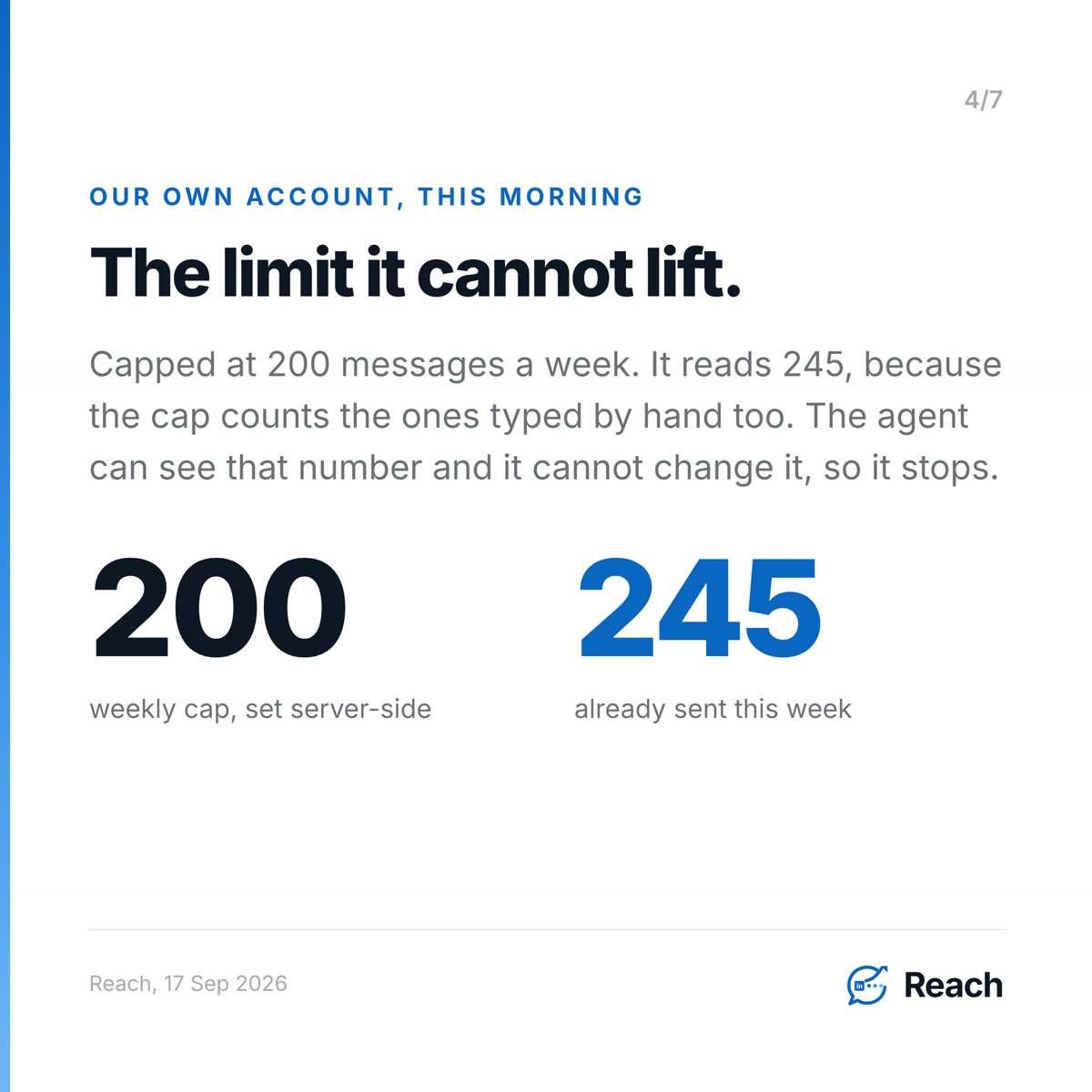
It should not be able to raise its own limits. Our account's LinkedIn identity is capped at 200 direct messages a week. This morning it reads 245, because the cap counts everything the human does by hand on LinkedIn too, and 40 of this week's messages were typed by a person, plus a second Reach account sharing the same profile. The agent can see that number. It cannot change it, and it stops. That is the "kill switch" line from the Harness survey, except it is a limit the agent was never given the tool to move.
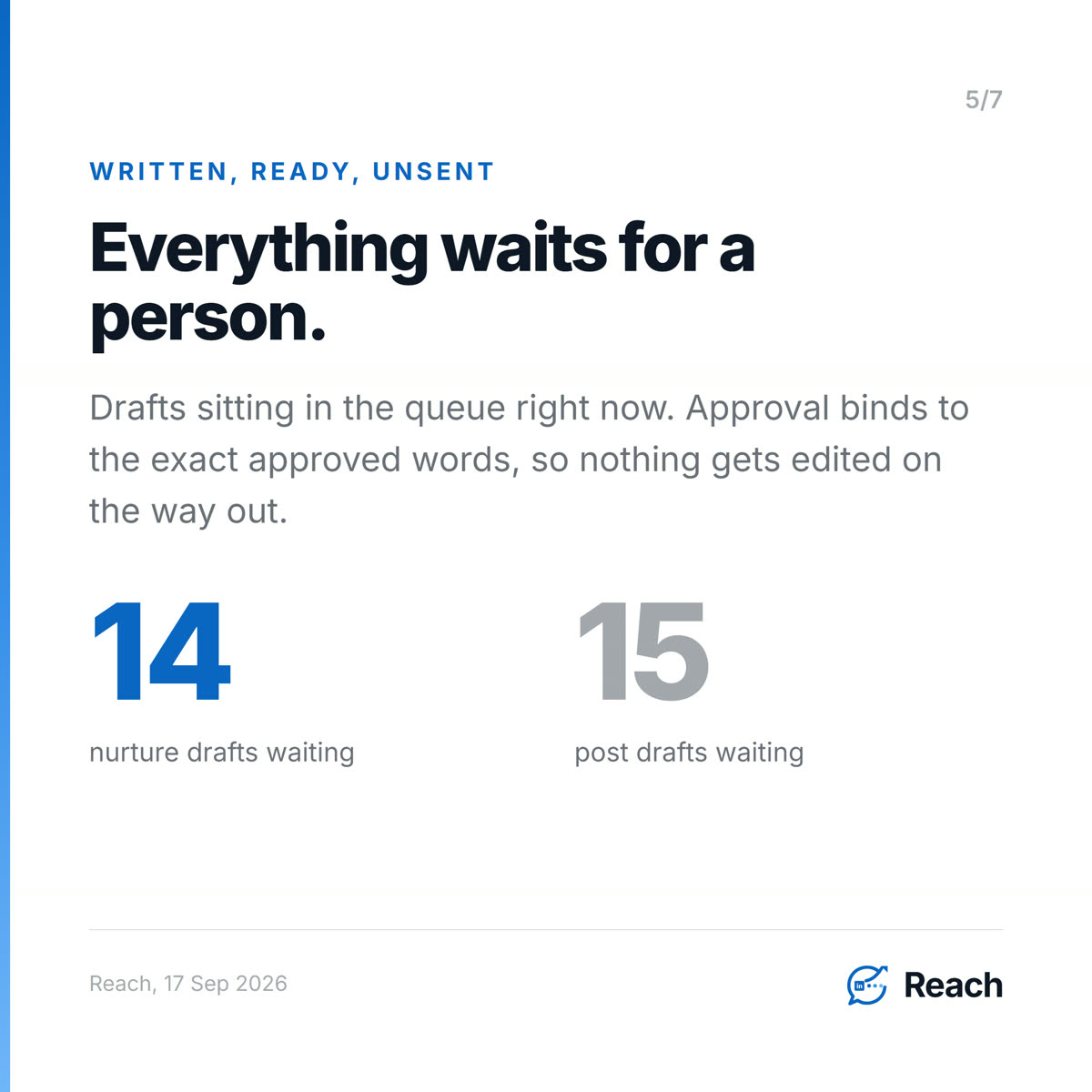
It should not be able to send on its own. Right now the account has 14 nurture drafts and 15 post drafts waiting for a human. They have been written, they are ready, nothing goes out. Approval binds to the exact approved text, so an agent cannot get a message approved and then edit it on the way out. We wrote up that whole model in AI sales agent human in the loop.
It should refuse to act when it cannot prove what happened. Three approved sends stopped mid-flight this week and Reach cannot prove whether they arrived. Nothing was resent. They sit parked for a human to open the thread and look, because a duplicate message to a warm contact costs more than a missed one. An agent that retries on uncertainty will eventually double-message somebody important.
The tools also hand the agent its own caveats, not just numbers. Asking for results this morning returned a positive reply rate of 25 percent with the line "Only 16 replies classified. Too few to conclude anything." attached to it. An agent reading that should not go and build a strategy on 16 replies, and it can only know that because the tool said so out loud.
Why point the agent at the network you already have?
Because that is where the agent's judgement is worth something. Our account has 15,938 people imported and never sorted, and 2,010 people who answered once and then went quiet for more than three weeks. These are not strangers. They are already connected, there is already a thread, and the work is deciding who is worth a message this week and what it should say. That is reading and ranking and drafting, which is what these models are good at.
The honest counterweight, from our own numbers: Reach sent 166 of 18,730 outbound messages in this account's history. The rest were sent by hand on LinkedIn. The agent is not running the account. It is doing the reading, the sorting and the first draft, and a human is still the one pressing send.
Common questions
Does an AI agent need my LinkedIn password?
No, and it should not have it. With a browser-based tool the work happens inside the session you are already logged into, and the agent talks to the tool rather than to LinkedIn. Anything asking you to hand over credentials so a server can log in for you is a different, riskier design.
Can an AI agent get my LinkedIn account restricted?
It can, if it sends like a bot. The protection is not the model, it is server-enforced weekly limits the agent cannot lift, plus the fact that a human reads each message before it goes. No tool makes a restriction impossible, and anyone claiming otherwise is selling you something.
What is MCP and why does it matter here?
MCP is the open protocol for handing an AI agent a defined set of tools. It matters because the tool list is the permission list. A narrow MCP server is a small, auditable surface, and a wide one is a standing offer to do anything.
Can I run my whole LinkedIn account from a chat window?
For the reading, planning and drafting, yes. Reach's MCP tools cover the plan, the pipeline, qualification, campaigns, proposals and results, so you can work the account from Claude or ChatGPT without opening the app. Sending still needs a person, and the extension in your browser still does the actual sending.
How do I tell a safe LinkedIn agent from an unsafe one?
Ask for the tool list. If you cannot get a straight answer about what the agent can do without asking you, assume it can do everything.
Reach is at reach.linkenite.com.
Sources
Every URL below was opened this run. WebFetch returned HTTP 403 on the OpenAI page, so it was opened in the built-in browser and read as page text, same as the Gartner precedent from 2026-09-16.
Trend anchor (primary, opened, verbatim-verified)
OpenAI, "Introducing the Agents API" https://openai.com/index/introducing-the-agents-api/ Dated on the page: September 10, 2026. Opened in-browser 2026-09-17.
Verbatim:
- "Today, we're introducing the Agents API in public beta, bringing that same harness and infrastructure that powers Codex to developers through a simple, flexible API."
- "The Agents API supports MCP, custom functions, and built-in tools like web search."
- "Useful agents need a powerful harness that manages context, uses tools efficiently, and coordinates subagents."
- "There are no additional fees for using the Agents API - you simply pay for the tokens and tools your agents use"
The first code sample on the page declares a tool of type: "mcp" with a server_label and an HTTP transport.server_url. That is the basis for the "six lines and it has hands" line in the deck and the post. No claim is made about OpenAI connecting to LinkedIn, because the page makes none.
Counter-signal (primary survey, opened, verbatim-verified)
Harness, "New Harness Report Reveals Enterprise Confidence in AI Agents Isn't Backed by Real Controls" (announcing The State of Agent DLC 2026) https://www.harness.io/press-and-news/new-report-reveals-ai-agent-confidence-gap Dated on the page: SAN FRANCISCO, September 10, 2026. Opened in-browser 2026-09-17.
Verbatim, used:
- "77% are confident they have a complete inventory of every agent, MCP server, and LLM in their environment, but only 44% run active discovery tooling to verify it."
- "76% believe they could disable a misbehaving agent in under 15 minutes, but only 33% have an instant kill switch in place."
Methodology, stated on the page and reproduced in the blog rather than hidden: "a survey of 700 technology professionals at large enterprises in the United States, United Kingdom, France, Germany, and India, conducted by Sapio Research in July 2026 on behalf of Harness. Respondents were screened for organizations with 1,000 or more employees, 100 or more developers, and annual revenue above $100 million ... Participation required that the organization had already deployed AI agents in production, in pilot, or at least in a live proof of concept".
Harness is a vendor publishing its own commissioned survey. It is cited with the methodology attached and it is not an outreach-automation vendor, so the persona's exclusion of outreach-tool marketing does not apply. Other figures on the page (75% security, 74% cost, 87%/88% incident rates, 42% prompt pipelines) were read and left out to keep the argument on inventory and rollback.
First-party (Reach MCP, this run, 2026-09-17)
get_account_state and get_results, both called this run:
- LinkedIn identity "Pravin Luthada":
weeklyDmCap200,dmsThisWeek245,weeklyInviteCap125,invitesThisWeek31. Account note, verbatim: "56 outbound actions this week were NOT sent by Reach - 16 invites and 40 messages sent by hand. They count against LinkedIn's weekly caps and against the contact budget just the same". awaitingHuman:touchProposals14,postProposals15.queue.uncertainSends3, with theget_resultscaveat verbatim: "3 approved sends stopped mid-flight and Reach cannot prove whether they arrived, so nothing was resent."positiveReplyRate0.25,sampleSize16, caution verbatim: "Only 16 replies classified. Too few to conclude anything."conflicts.untriagedPeople15,938. Account note: "2010 engaged leads have gone quiet for over 21 days and have no draft waiting".get_resultscaveat verbatim: "Reach sent 166 of 18730 outbound messages in this history - the rest were sent by hand on LinkedIn."
Feature grounding (shipped only)
docs/STATE-OF-THE-SYSTEM.md, "Working product": "scoped MCP tools for account reads, planning, campaigns, proposals, assets, and outcomes". Safety invariants quoted or paraphrased: #1 "Server code never calls LinkedIn", #6 "Campaign, account, weekly, and monthly limits are enforced server-side", #7 "Agents cannot change the human objective, mint tokens, or raise limits", #8 "Approval receipts bind to the exact approved content."
Internal links (all verified HTTP 200 before publish, 2026-09-17)
- https://reach.linkenite.com
- https://www.linkenite.com/blogs/2026-09-08-turn-linkedin-connections-into-a-crm
- https://www.linkenite.com/blogs/2026-09-15-ai-sales-agent-human-in-the-loop
Opened and deliberately not used
- aiagentstore.ai weekly AI-agents digest (opened). Used only to find candidate items. It carries no source links, and a "Beyond the Chatbox" item that surfaced in search did not appear on the live page, so nothing from it is cited.
- Salesforce Agentforce / AIforce announcements, 11-16 Sep 2026. Dated and on-arena, but competitor framing, and deliberately skipped on 2026-09-15 and 2026-09-16 for the same reason. Skipped again.
- Anthropic CEO "agent swarms" warning, 13-14 Sep 2026. No primary opened, and the framing is fear-based, which the persona and VOICE.md both rule out.
- Gartner "40% of enterprise applications will be integrated with task-specific AI agents by 2026". Already used on 2026-08-31, not reused.


.png)
.png)
.png)
.png)
.png)
.png)
.png)
.png)
.png)
.png)
.png)
.png)

.png)
.png)
.png)
.png)


.png)
.png)

.png)


.jpg)

.jpg)
.jpg)


.png)


.png)

.png)
.png)
.png)


.png)
%20(2).png)
.png)
.png)




.png)

.png)


.png)


.png)


.png)


%20BLOG%20BANNER.png)


.png)