
To track LinkedIn leads without updating a CRM, stop asking anyone to log anything and let the account record the events that already happen. A connection accepted, a reply arriving, a meeting booked - each one moves that person a stage on its own evidence. The record stays accurate because it is derived from what occurred, not remembered by whoever was busiest that week.
Reach is a LinkedIn tool that runs in your own browser, inside your own logged-in session, and builds a pipeline record out of what actually happened in your LinkedIn account. No password is handed over and no server calls LinkedIn.
Why do LinkedIn leads disappear?
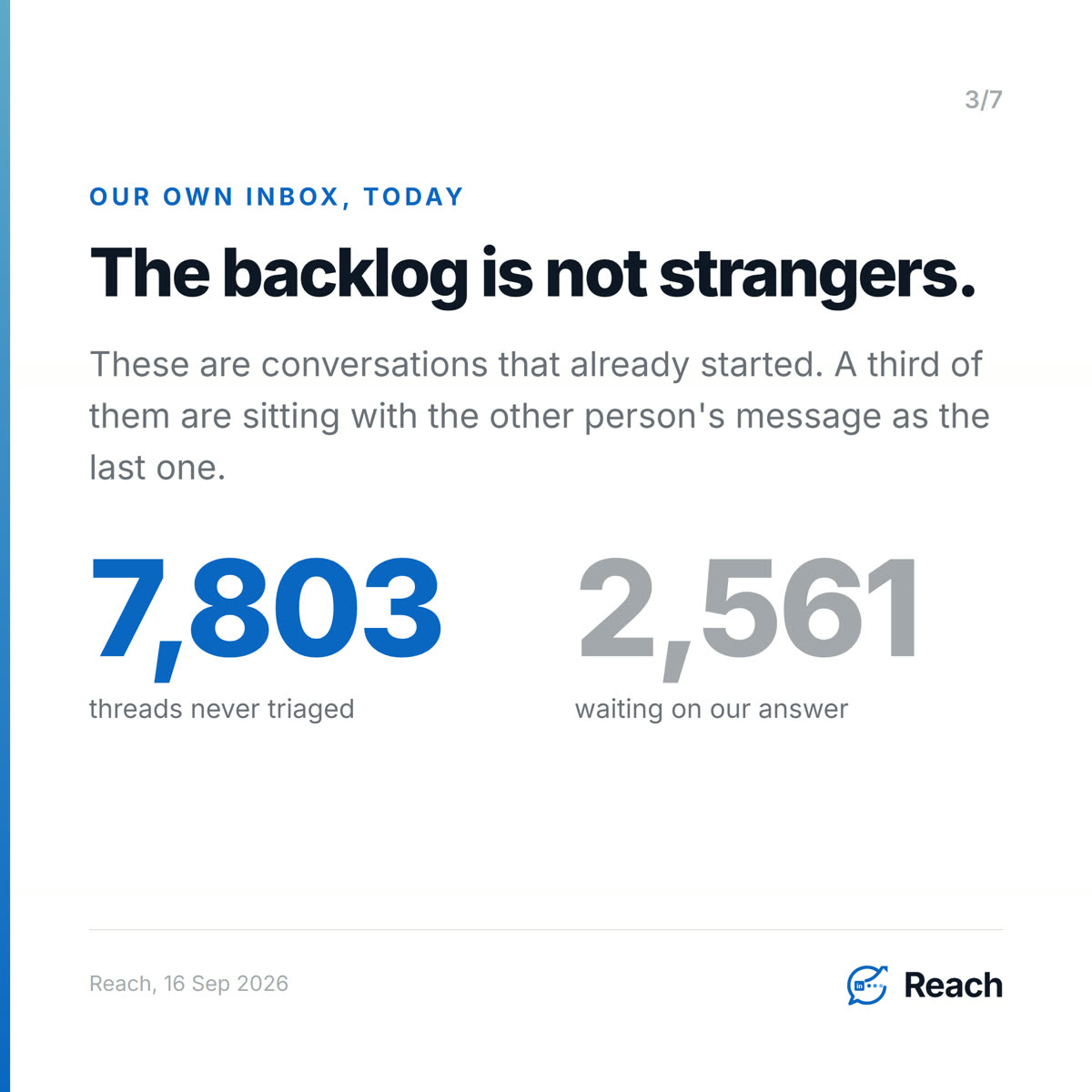
They disappear because nothing wrote down that they were ever leads. A LinkedIn conversation has no stage field. Someone accepts, replies once, says "interesting, send me something" and then goes quiet. Two weeks later that thread is 40 threads down the inbox and functionally gone. It is not lost to a competitor. It is lost to scrolling.
This is the part most people underestimate. On this account today there are 7,803 LinkedIn threads that have never been triaged, and 2,561 of them are sitting with the other person's message as the last one. That is not a backlog of strangers. Those are conversations that already started.
What should you track instead of activity?
Track state, not effort. Messages sent is an activity number and it goes up whether or not anything is happening. What you need to know for each person is where they actually are and what moved them there.
Gartner's sales research makes the same point from the other direction. In a May 2026 release the firm reported that sales organisations giving sellers AI-enabled next best actions are "2.6x more likely to achieve commercial growth", from a survey of 227 chief sales officers run from August through September 2025. A next best action is only computable if something already knows the person's current state. Without that, you get a suggestion generated from nothing.
How to track LinkedIn leads automatically
Promote people on observed events, and record what the evidence was. That is the whole mechanism, and it is the one Reach ships:
- Someone accepts your connection, and they move from awareness to interest.
- An inbound message lands after one of yours, and they move to consideration. An actual reply, not an open or a view.
- The reply reads positive, or the agent records qualified interest, and they move to intent.
- A meeting is booked or held, and they move to evaluation.
Every move is stamped with when it happened, what caused it, and whether it came from the system, the agent or a human. So the pipeline is auditable rather than asserted. Nobody sat down on a Friday and guessed.
The same record answers the question nobody has a good answer to otherwise: who went quiet. A person with a last inbound date and no outbound since is a different problem from a person who never answered at all, and they need different handling. You can read what Reach does with that list, and the related rule that a reply hard-stops automated follow-up for that person.
What the numbers look like on a real account
This is our own LinkedIn account, read on 16 September 2026, and it is not flattering.
The tracked pipeline holds 110 people. 37 of them are qualified against the target profile. 65 are waiting on a reply right now. Underneath that, 2,008 engaged leads have gone quiet for more than 21 days with no draft waiting for them, and 15,929 people in the network have never been triaged at all.
The outcomes that did get recorded are small and real: 12 people marked as qualified interest, 2 meetings booked, 4 email addresses obtained, 8 replies classified. Eight is too few to conclude anything from, and the tool says so itself rather than rounding it into a win rate.
The campaign numbers say the rest. A message campaign to 110 C-level people already in the network sent 108 and got 17 replies. A 43-person campaign to already-connected sellers sent 43, got 14 replies, and 33 of those people are now warm. Ten messages written entirely by hand to dormant contacts got 4 replies. Small samples, all of them, and worth copying rather than quoting as a benchmark.
One honest caveat, because it matters for how you read any of this: Reach sent 154 of the 18,702 outbound messages in this account's history. The rest were sent by hand. The pipeline record covers the account, not just the tool.
Does an AI agent fix this?
Not on its own, and this is where the trend is heading badly. In a 28 July 2026 release, Gartner predicted that "By 2028, AI agents will outnumber sellers by 10 times, yet fewer than 40% of sellers will say AI agents have improved productivity." Dan Gottlieb, VP Analyst in the Gartner Sales practice, warned that without the right foundation leaders "risk creating agent sprawl, with more digital activity, but little improvement in seller impact."
The line worth keeping is his next one: "If those systems are fragmented, the agents will scale the fragmentation." Gartner's own recommendation is to "Build a centralized context layer that connects enterprise data, systems and seller judgment" before pointing agents at the problem.
A pipeline record is that context layer, at the small end. Point an agent at an account with no record of who is where, and it will do what it is told very efficiently, which is to message more people. Point it at a record built from observed events and it can do the harder, duller, more valuable thing, which is to go back to the 2,008 people who already answered once.
That is the same argument as working the network you already have, applied one step later in the process. Finding the person is the first half. Not losing them is the second.
Common questions
How do I track LinkedIn leads without a CRM?
Use a system that derives stages from LinkedIn events instead of asking a person to log them. Connection accepted, reply received, meeting booked are all observable, so the pipeline can be built from them without anyone typing.
Can LinkedIn itself track my leads?
Not in the way a pipeline needs. LinkedIn shows you threads and connections, with no stage, no evidence trail and no view of who has gone quiet. Sales Navigator adds lists and alerts but still does not record a buying stage derived from your own conversations.
What counts as a real engagement signal on LinkedIn?
An inbound message that arrives after one of yours is the strongest and simplest. Accepting a connection is weaker but still real. Profile views and likes are much weaker and should not move someone up a stage on their own.
Why do warm LinkedIn leads go cold?
Usually nobody noticed. A reply arrives, it gets read, it does not get answered that day, and the thread moves down the inbox. Tracking a last-inbound date per person is what turns that from a memory problem into a list.
Is it safe to track LinkedIn leads with an automation tool?
It depends entirely on where the tool runs. Reach runs as a Chrome extension inside your own logged-in session, so no password is shared and no server calls LinkedIn on your behalf. Tools that ask for your LinkedIn credentials and drive the account from their own infrastructure are a different risk.
Sources
Every URL below was opened and read on 2026-09-16. Figures were verified in the document itself, not from a search summary.
Primary - Gartner, 28 July 2026 (opened in-browser, verbatim-verified)
"Gartner Predicts AI Agents Will Outnumber Sellers 10 to 1 by 2028, Yet Fewer Than 40% of Sellers Will Say Agents Improved Productivity" https://www.gartner.com/en/newsroom/press-releases/2026-07-28-gartner-predicts-ai-agents-will-outnumber-sellers-10-to-1-by-2028-yet-fewer-than-40-percent-of-sellers-will-say-agents-improved-productivity
Dateline verbatim: "STAMFORD, Conn., July 28, 2026"
Verbatim quotes used:
- "By 2028, AI agents will outnumber sellers by 10 times, yet fewer than 40% of sellers will say AI agents have improved productivity"
- Dan Gottlieb, VP Analyst in the Gartner Sales practice: "Without the right data foundation, workflow integration and seller experience, CSOs risk creating agent sprawl, with more digital activity, but little improvement in seller impact."
- Gottlieb: "If those systems are fragmented, the agents will scale the fragmentation."
- Recommendation verbatim: "Own AI-forward sales infrastructure: Build a centralized context layer that connects enterprise data, systems and seller judgment so AI agents can generate more relevant, enterprise-specific outputs."
Methodology stated in the release: "A Gartner survey of 210 CSOs and senior sales executives conducted from January through February 2026 found that 60% of CSOs say their revenue number is largely driven by elements outside of their control". (The 60% figure was read but is not used in the blog.)
WebFetch returned HTTP 403 on this URL. It was opened in a real browser instead and the article body extracted directly from the page.
Primary - Gartner, 20 May 2026 (opened in-browser, verbatim-verified)
"Gartner Survey Finds Sales Organizations That Provide AI-Enabled Next Best Actions Are 2.6x More Likely to Achieve Commercial Growth" https://www.gartner.com/en/newsroom/press-releases/2026-05-20-gartner-survey-finds-sales-organizations-that-provide-ai-enabled-next-best-actions-are-two-point-six-times-more-likely-to-achieve-commercial-growth
Dateline verbatim: "LAS VEGAS, Nev., MAY 20, 2026"
Verbatim quotes used:
- "Sales organizations that provide sellers with AI-enabled next best actions are 2.6x more likely to achieve commercial growth"
- "A survey of 227 chief sales officers (CSOs) conducted from August through September 2025"
- "AI is well suited to activities, such as account research, personalized messaging, signal monitoring and next best actions, while sellers remain differentiated in empathy, judgment, contextual understanding and value framing." (read, informs the argument, not quoted in the blog)
First-party - Reach, 16 September 2026
From get_account_state and get_results on this account, this run:
- Tracked pipeline: 110 people, 37 qualified, 65 awaiting a reply.
- Verbatim note: "2008 engaged leads have gone quiet for over 21 days and have no draft waiting; they can be re-approached with send_or_propose."
- untriagedThreads 7,803; untriagedAwaitingReply 2,561; untriagedPeople 15,929.
- Recorded outcomes: qualifiedInterest 12, meetingsBooked 2, emailsObtained 4, 8 replies classified with the tool's own caution verbatim: "Only 8 replies classified. Too few to conclude anything."
- Campaigns: "C-level executives India Region Existing network" 108 sent / 17 replied; "Reach - browser-first sellers (v2, sendable rows)" 43 sent / 14 replied / 33 warm; "Reach - 10 hand-written 1:1s to dormant network" 10 sent / 4 replied.
- Caveat verbatim: "Reach sent 154 of 18702 outbound messages in this history - the rest were sent by hand on LinkedIn. These results describe the ACCOUNT's outreach, not Reach's campaigns".
Feature verification (shipped)
docs/STATE-OF-THE-SYSTEM.md: "a pipeline built from observed engagement signals".shared/schema.ts:1205engaged_leadstable:stage,stage_updated_at,stage_history(each entry carriessource: "auto" | "agent" | "user"and an optionalevidencestring),last_outbound_at,last_inbound_at.server/storage.ts:5165-5210the stage promotions used in the blog:connected_atpromotes awareness to interest; an inbound message later than an outbound one in the same conversation promotes to consideration; a positivereply_sentimentor aqualified_interestoutcome promotes to intent; ameeting_bookedormeeting_heldoutcome promotes to evaluation.


.png)
.png)
.png)
.png)
.png)
.png)
.png)
.png)
.png)
.png)
.png)
.png)

.png)
.png)
.png)
.png)


.png)
.png)

.png)


.jpg)

.jpg)
.jpg)


.png)


.png)

.png)
.png)
.png)


.png)
%20(2).png)
.png)
.png)




.png)

.png)


.png)


.png)


.png)


%20BLOG%20BANNER.png)


.png)